
How Tradovate connects
Direct OAuth sync for Demo and Live accounts, or CSV import from the Reports area.
Direct sync
Tradovate Trade Sync
Connect one or more Tradovate identities with OAuth on Journalit.co, then choose accounts, history, and journal mappings in the Journalit plugin.
Read the setup guideFile import
Tradovate CSV import
Export the Reports → Orders export (CSV) and import the original file without editing it in a spreadsheet first.
Read the export guideDirect sync and file import are separate workflows. Use sync for ongoing automation and file import for one-off history.
Exactly what is supported
The same facts we maintain for support, published instead of hidden. If something here is wrong, it is a bug.
What gets captured
- Closed and open positions, with one trade note per position across its open, partially closed, and closed lifecycle
- Initial history you choose per account: all history Tradovate currently exposes for that account, a recent period, a custom date, or new trades only. All available is not a guarantee of complete account-lifetime history
- Ongoing activity while the app is closed; your journal catches up when Journalit reconnects
Account types
- Demo
- Live
Honest limitations
- Connection management and synchronisation require an eligible Journalit plan
- When the same canonical account is visible through two OAuth identities, only one connection can sync it at a time
- Existing open positions are synchronised even when an initial-history boundary excludes older closed trades
Your trade history stays on your computer
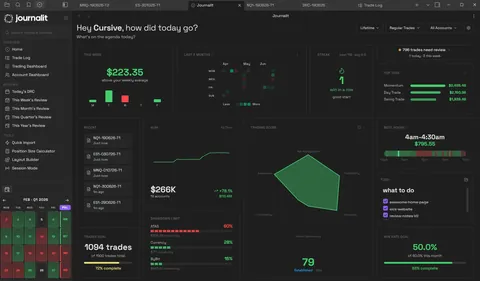
Tradovate activity becomes trade notes stored as plain files on your device, inside Obsidian, the free note-taking app Journalit runs on. Your thesis, tags, screenshots, reviews, and custom fields are never replaced by broker updates.
Before you connect Tradovate
Free vs Pro
Journalit is free for journalling, analytics, reviews, and templates. Pro unlocks Trade Import, automatic trade sync, the Economic Calendar, and prop-firm profiles.
Free
Manual journaling, flexible reviews, and analytics on your device.
INCLUDES
- Unlimited trades & accounts
- Journal stored on your device
- Custom fields & properties
- Rich markdown notes
- Analytics dashboard
Pro
Billed annually at $180/year
Skip the spreadsheet cleanup. Sync and import trades into the journal you already review.
EVERYTHING IN FREE, PLUS
- Automatic Trade Sync for supported brokers
- Trade Import for broker exports and statements
- Economic Calendar with weekly event imports
- Prop-firm profiles that prefill challenge rules
- Multi-account sync support
- Priority support